
History May Not Repeat Itself
The second essay in the cross-posted series on "A Pamflyt Compiled of Cheese"
N.B. This article is being cross-posted on the Ampersand Book Studio Substack, where my bookwright/husband is in the middle of letterpress printing the first published edition of a 1580 manuscript housed at the University of Leeds. It is called “A Pamflyt Compiled of Cheese” of unknown authorship. I tend to call the author our “pamflyteer.”
I was wondering who said “History does not repeat itself, but it often rhymes.” I found it attributed most often, although apparently incorrectly, to Mark Twain. A few sites claimed it was from Theodore Reik, a psychiatrist who published an article in 1965. Some discussed the Reik quote as if it were as quippy as the quip. It’s not. He wrote: “It has been said that history repeats itself. This is perhaps not quite correct; it merely rhymes.”
At his Quote Investigator site, Garson O’Toole has a more nuanced look into the concept behind the quip and its rather common-sense truth. Rather than simply asserting or dissenting from individual attribution, O’Toole shows how the idea has been bouncing around in people’s heads and popped up numerous times. It has been put, as a result, in different ways. It simply may be that it is obvious, if rather clunky to say, that we can see comparable dynamics in different historical eras. Some people have said it better than others. O’Toole finds that Twain actually did publish a similar sentiment in 1874: “History never repeats itself, but the Kaleidoscopic combinations of the pictured present often seem to be constructed out of the broken fragments of antique legends.”
Perhaps history never really does repeat and we interpret past events through our own lenses. History was once legend, and each generation re-assembles its broken fragments in its own image. We make our present a kaleidoscope of the past. Or vice versa. History never repeats itself, but we keep trying to see it that way.
“Kaleidoscope” is a nice word from the 19th century that was created by gluing three Greek words together: kalos (beautiful), eidos (shape) and scope (an instrument for seeing). In that way, the word reflects the vast number ways that past sights and insights can be formed and reformed.
But It Often Rhymes
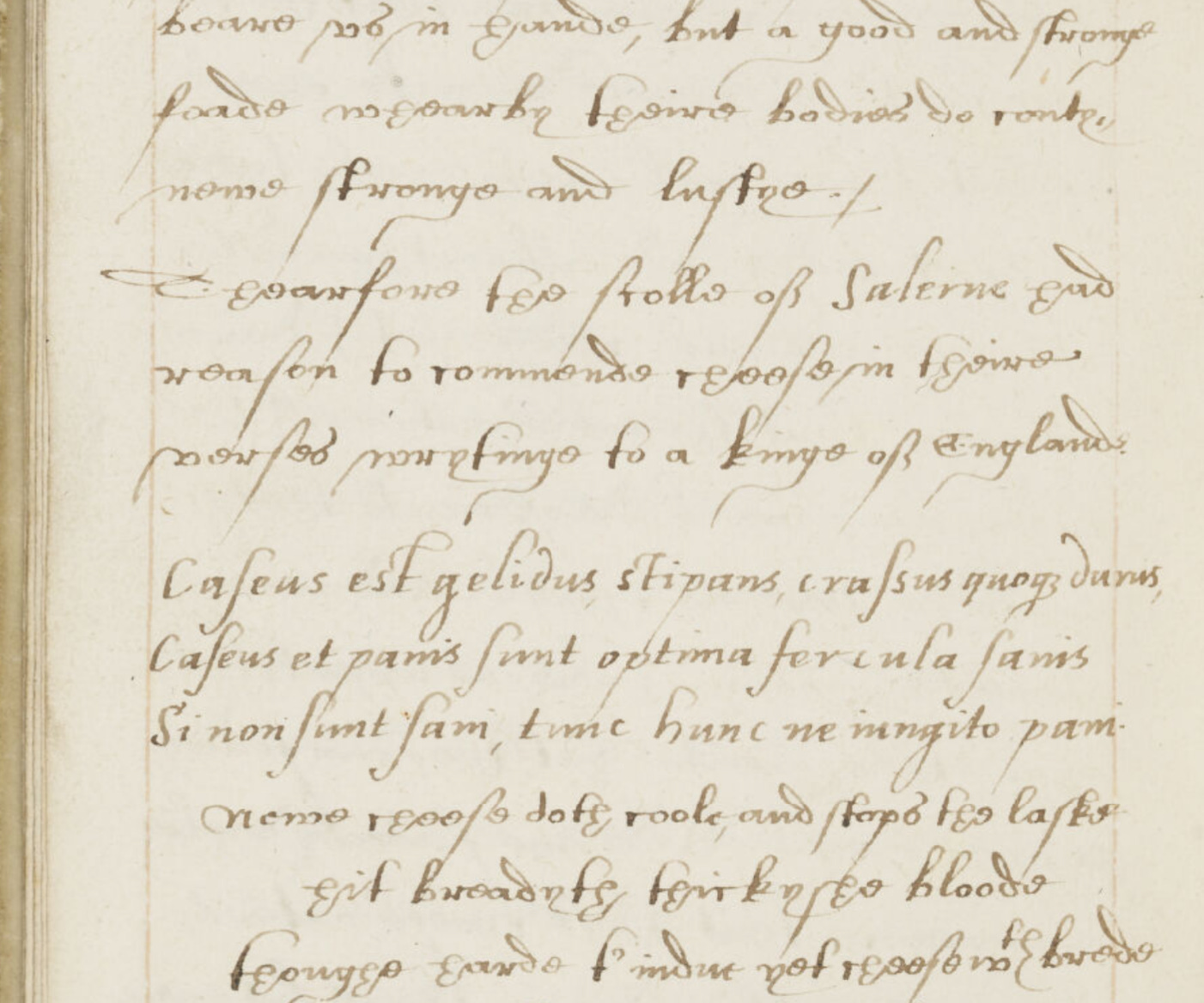
The reason kaleidoscopes are considered toys is because turning one lets you see something unexpected. Whether or not the pattern is beautiful, it is always refreshing. I am very pleased to share with you something refreshing that I have learned from turning the Pamflyt round and round. A few weeks ago I was reading — aloud, because it does make more sense, just like Shakespeare or the King James Bible, when you give voice to the words — from Ruth Bramley’s transcription. I stubbed my tongue, as it were, on a section. Here it is, from page 68:
Thearfore the scolle of Salerne had reason to commende cheese in theire verses wrytinge to a kinge of England: Caseus est gelidus stipans crassus quoque durus Caseus et panis sunt op ma fercula sanis Si non sunt sam me hunc ne ingito pam Newe cheese doth coole, and stops the laste hit breadeth thickyshe bloode Thoughe harde t’indure yet cheese with brede for wholle men is full good The sicke and weke for their repaste may seeke some other foode
The “scolle of Salerne” is the famous medieval medical school in Salerno, Italy. (The King of England is another story for another time.) The Schola Medica Salerni had its own medical textbook, the Regimen Sanitate Salerni. The edition of the Regimen with commentary from a doctor named Arnaldus of Villanova was one of the most popular incunabula across Europe. (Incunabula are books printed in the first 50 years of the printing press.) The pamflyteer would have been very familiar with such a book. He clearly knew the Latin edition. He may also have had the 1528 English translation, which was reprinted a number of times. He restates the Latin from the Regimen in his own words. The capitalization, and something about how it sounded when spoken, made me want to arrange the words differently. With the spelling modernized, it looks like this:
New cheese doth cool, and stops the last
   it breadeth thickish blood.
Though hard to endur yet cheese with bread
   for whole men is full good.
The sick and weak for their repast
   may seek some other food.
It is a poem. It rhymes! Especially if you know a bit about Shakespearean English, you know how “blood” and “good” and food” all sound alike. Before the “Great Vowel Shift”. (long story) changed our pronunciations, you would hear how these are, indeed, verses. When I looked back at the Regimen’s Latin, I realized that it was in rhyming verse, too, in a kind of a-a-b-b-c-c way. I’ve highlighted the rhymes, because it is recognizable even if you know no Latin:
Caseus est gelidus
  stipans crassus quoque durus
Caseus et panis
  sunt op ma fercula sanis
Si non sunt sam
  me hunc ne ingito pam
There is a lot going on here. First of all, the Regimen Sanitate Salerni is in rhyming verse. Second of all, the translation of the Regimen is in rhyming verse. The English is rather strained, which only goes to show how important it was to retain the rhyming. This is not usually what is prioritized today when works are being translated. It clearly was then.
How far back does this priority of rhyming go? And why was a medical textbook in verse at all? Emilie Savage-Smith demonstrates that this practice goes back at least to 800 AD/CE. In her masterful work for the online Islamic Medical Manuscripts project, Professor Savage-Smith describes this phenomenon in her “A Note on Medical Poetry”:
Arabic didactic verse was intended to provide an accessible and easily remembered summary of a particular field of knowledge. Medical poetry became a popular device for learning simple concepts of therapeutics and regimen, because the rhyming quatrains enabled the student or practitioner to quickly retain the basic ideas…. The poems were usually written in rajaz verse, which is a kind of iambic meter whose pattern of syllabic repetitions produces a jingling sound that is particularly easy to remember. This poetic form of instruction was immensely popular in medieval literature and numerous examples are preserved today, some of them written by very prominent figures.
I love how she describes the iambic meter of rajaz verse as “jingling,” like an advertiser’s jingle you cannot get out of your head. (People of a certain age will curse me when they read the next four words: Plop, Plop, Fizz, Fizz.)
Professor Savage-Smith later adds, with more than a whisper of regret, that “Most examples…are unpublished, for the use of didactic poetry to teach serious subjects such as medicine has long fallen out of fashion and has not attracted much attention from historians.” Would that our focus on The Pamflyt Compiled of Cheese could revitalize the composition of doggerel for all academic disciplines. (The S.T.E.M. folks would lose their minds.)
It turns out that Ibn Sina (980-1037), who was called Avicenna in Latin translations of his work (and appears in the Pamflyt), was widely known for his medical poetry. Professor Savage-Smith explains:
The most well-known Arabic didactic medical poem was that called simply “A poem on medicine” (Urjūzah fī al-ṭibb) written by Ibn Sīnā (Avicenna). Judging from the large number of manuscripts preserved today, it was especially popular, and it inspired a number of commentaries, including an important one by the Spanish physician Ibn Rushd (Averroes).
So the medical knowledge that was preserved through the ages, that vast treasure trove of Galenic “humoral” information, was often made accessible not only by being brought into the lingua franca of its day, time, and place. Some of it was kept accessible by retaining its rhymes. The essentials of Avicenna’s medical tome, his Canon, was condensed and put into rhyming verses by Avicenna himself. When Averroes wanted to analyze and argue with Avicenna’s approach to Galen, he responded directly to the “Poem on Medicine,” not the Canon.
Who Was in the Pamflyt?
But I have skipped ahead of myself. In my previous essay, I discussed Galen, but not the many other medical doctors, translators, philosophers, and, yes, poets, found in the Pamflyt. Avicenna and Averroes are two of many. And while the tables below are not exhaustive, they do point to the fact that the pamflyteer sees himself as enmeshed in a whole tradition of medicine. He expects the reader to know the books he cites and the individuals who wrote them. Using the page numbering in the online Bramley transcription, which follows the original manuscript1, the chronologically earliest references in the Pamflyt include:
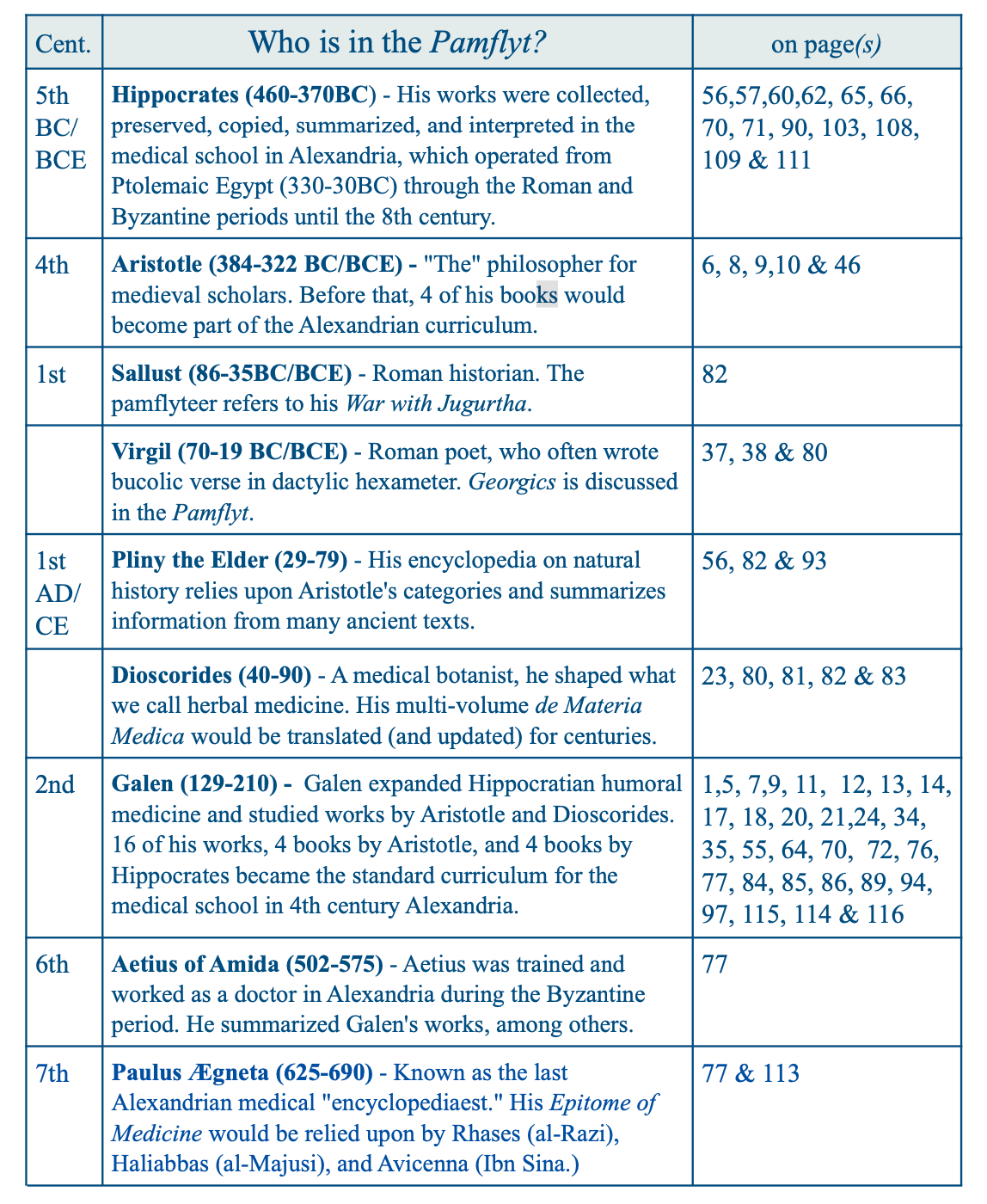
This puts Galen in context. For one thing, he was a luminary at the medical school in Alexandria, Egypt, but he was hardly the first or the last to study there. Historians call a number of these folks, even when they were practicing doctors, “encyclopediaests”. They would copy, summarize, expand upon, and systematize the medical works from the past.
When we come to the Romans, something else can be learned. Didactic poetry dates back even further. Virgil’s poem Georgics offers practical advice on how to run a farm, including techniques for animal husbandry and beekeeping. And while you may not have been assigned to read Virgil, our pamflyteer certainly was. Virgil would have been part of any standard grade-school curriculum in the Tudor era. Shakespeare was taught Latin and read Roman texts as a boy in Stratford-upon-Avon.
The last two, Aetius of Amida and Paulus Aegenta, would have been known to medical students. With Paulus Aegenta, in particular, we see the explicit historical links to later doctors and scholars found in the Pamflyt:
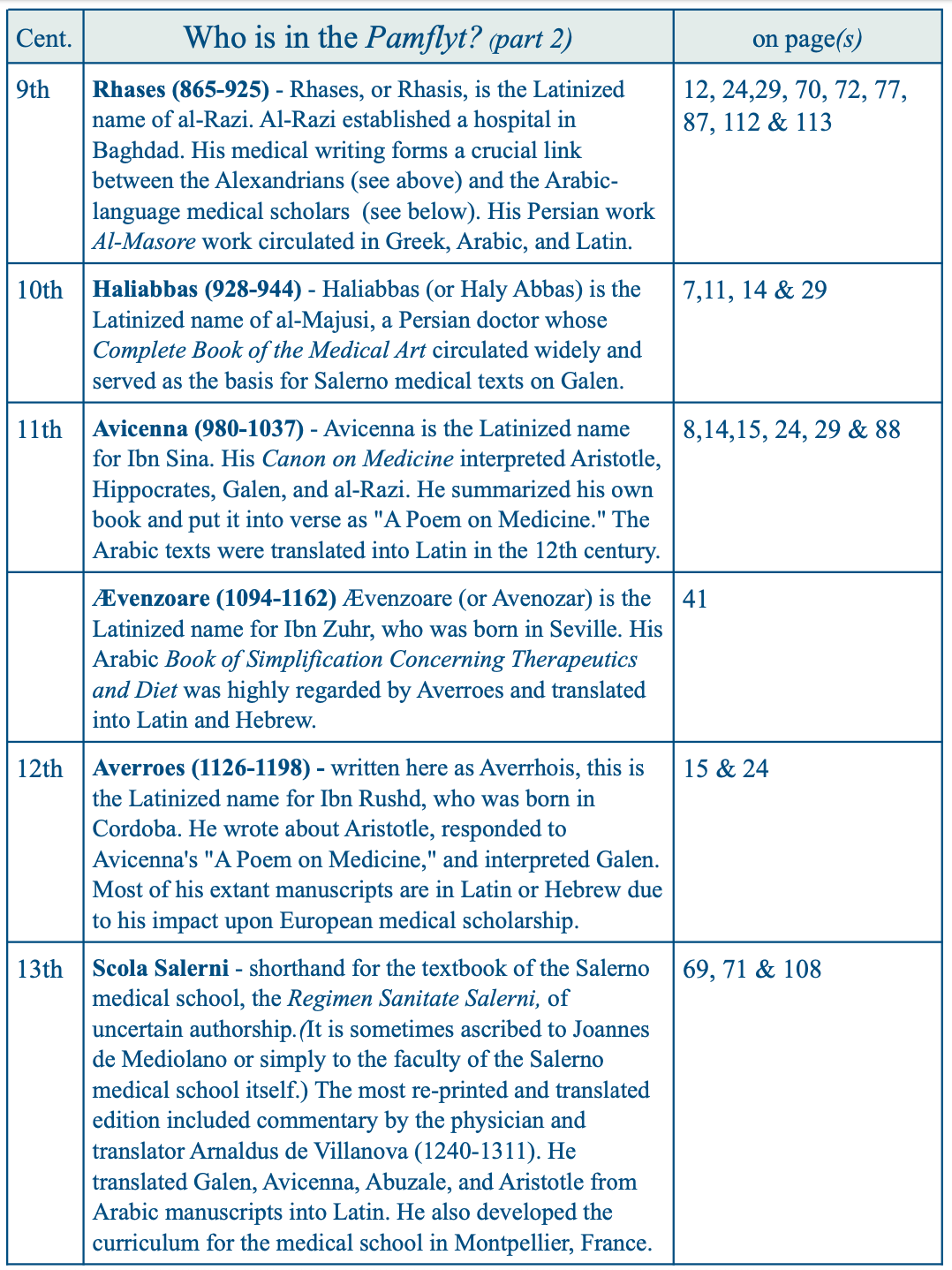
You can see the palpable shift in these two tables, how Greeks (and Greek doctors) were considered the best, right through Roman times. The lingua franca of the educated was Greek even when daily talk was Latin. The second table is populated mostly with scholars from what is called the Islamic Golden Age. (Because many of those involved were not, in fact, Islamic, scientific historians like Jim al-Kahlili call this the Age of Arabic-language Science instead.) By the 9th Century, the time of al-Razi, it is Arabic that is the lingua franca of the educated. Even Avicenna, who was Persian, wrote in Arabic. Baghdad’s “House of Wisdom” spawned similar library-building and manuscript translation projects in Damascus, Cairo, and in Al-Andalus (Islamic Spain)2. Cordoba and Toledo were some of the Andalucian locations where both Islamic and Christian leaders supported similar efforts. They have come to be called by historians today “Translation Movements.” (I have also posted an article about Translation Movements)
The School of Salerno’s textbook is from the late 13th century. The familiarity the Pamflyt writer has with all of these medical texts can make you forget how incredible it is that they were available in the Tudor era, much less today. There are more years between Salerno’s Arnaldus de Villanova and our pamflyteer than make up the whole history of the United States government. Over 250 years.

Back to the Pamflyt: Rapid change can make people draw a line. The printing press had been around for more than a century when the Pamflyt Compiled of Cheese was written in 1580. It was written by hand with care. In two hands, if you agree with Ruth Bramley and Tamsin Bacchus (of Kentwell Hall) that the Latin quotes are in different penmanship that the rest of the book. Our Pamflyt writer may have had no interest in watching his words get scrambled into moveable type.
What is a Prosopopaeia - and Where Can I Get One?
The fact that medical verse was not a risible idea to doctors in the past is surprising enough. The Pamflyt also allows us to experience a particularly hardy rhetorical device in poetry. It is called the prosopopaeia.
According to Professor Harriet Soper, prosopopaeia “originally meant kind of giving a face to something.” From the Greek words prosopon (face or person) and poiein (to make, create), this poetic device involves making an argument on one’s own behalf. It is a bit more extensive than mere personification or simple anthropomorphizing.3 While the Lorax may say, “I speak for the trees,” in an instance of prosopopaeia, the trees speak for themselves.

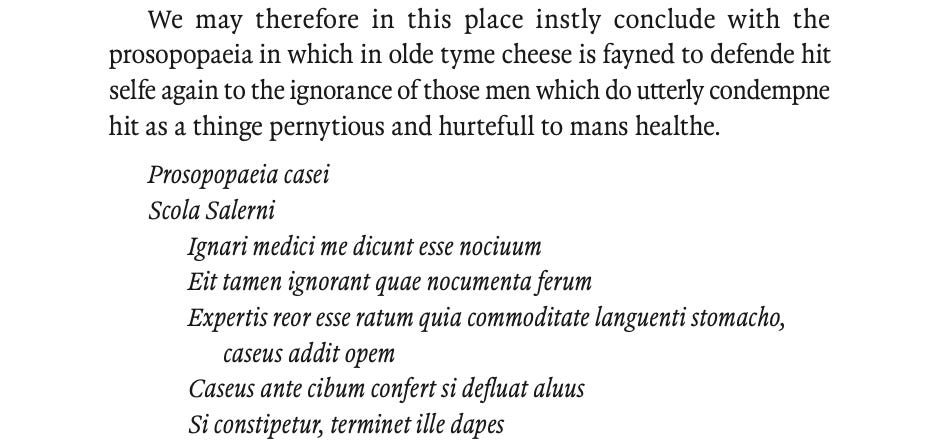
While our trusty pamphlyteer is a worthy advocate for cheese, be it British, Welsh, or otherwise, he has enough respect to let Cheese speak for itself. Quoting from folio 34 of the School of Salerno’s Regimen, Cheese tells us that it has been much maligned by those ignorant medical foks, “ignari medici", who do not appreciate its virtues.
Our pamflyteer refers familiarly (but respectfully) to “old tyme cheese,” who has something to say. Cheese must “defende hit selfe“ against “the ignorance of those men” who “utterly condempne” it as unhealthy. From the (preliminary) reproofed and reformatted Ampersand edition text, which Tristan and Ruth are collaborating on, the prosopopaeia section is set off as the poem that it is:
In his English translation, the pamflyteer repeats the title of the poem (“The Cheese’s Prosopopaeia” would be how we would do it4) and translates its Latin into rhyming couplets:
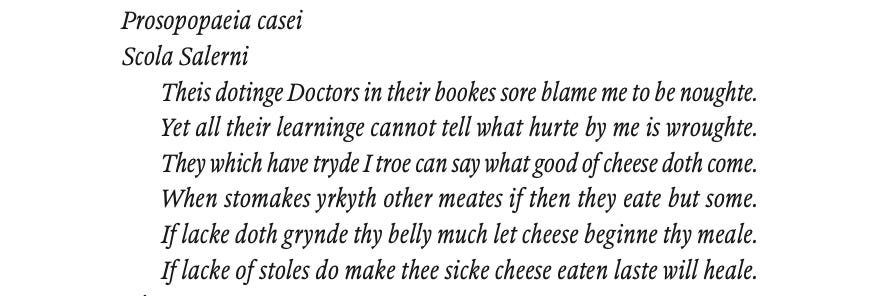
Cheese says its piece. And Cheese sounds cheesed off! The over-educated idiots with “all their learninge” may blame cheese, but they cannot prove any harm is done. They “cannot tell what hurte by me is wroughte.”
Rather than simply complain, Cheese begins teaching three lessons in digestion. First, for a stomach which has been “irked” (or upset) by meat, eating some cheese will settle it down. Secondly, if hunger “doth grind the belly” (and who has not heard a stomach groan before a meal), then Cheese recommends having cheese as the meal’s appetizer. Finally, cheese can heal a “lack of stoles” — how the Latin constipetur is translated — by being served as the last course of a meal. And, indeed, to this day, cheese as a final course is offered at many fine restaurants. A cheese board is also often available, at a wider variety of eating establishments, as an appetizer.
Verses are found in poems. And songs. I have been trying to find a song that fits the Prosopopaeia Casei, the “Rhyme of the Old Tyme Cheese.” Perhaps an accomplished rap/hip-hop singer could make it work. DJ Cheese could be like, “These doting doctors in their books sure shame me like I’m crap / But all their ‘education’ cannot tell them where I’m at.” (Yes, it’s bad. I know.)
I wonder about this because I’ve found myself breaking into song of late. When the video for the Kickstarter launch was being edited, we had “Greensleeves” playing over and over at home. It must have wrought a little bit of mischief in my brain, for I found myself singing the following poem to the tune of “Greensleeves” (or, at Christmastime, “What Child is This”):
‘Twas brillig, and the slithy toves
      Did gyre and gimble in the wabe:
All mimsy were the borogroves,
      And the mome raths outgrabe.
Beware the Jabberwock, my son!
      The jaws that bite, the claws that catch!
Beware the Jubjub bird and shun
       The frumious bandersnatch!
Perhaps I was being visited by the ghost of BBC Game Shows Past. “I’m Sorry I Haven’t a Clue” used to have that challenge of singing the words of one song to the tune of another. I so enjoyed singing Lewis Carroll’s poem to “Greensleeves” that I foisted it on nearby friends and relatives. My gift of levity for the season. I’m sure most of them were rolling their eyes, but my eyes were closed in the fervor of melody. And so I imagine Olde Tyme Cheese standing tall, an index finger in the air, proclaiming its worth in verse. Doting doctors, take note.


Bibliography and Online Resources
Books
Al-Khalili, Jim. The House of Wisdom: How Arabic Science Saved Ancient Knowledge and Gave Us the Renaissance, New York, Penguin Press, 2010.
Alwishah, Ahmed, and Hayes, Josh, Aristotle and the Arabic Tradition, Cambridge, Cambridge University Press, 2015.
Constable, Olivia Remie, ed., Medieval Iberia: Readings from Christian, Muslim, and Jewish Sources, Second edition, published by the University of Pennsylvania, Philadelphia, 2012.
Griffith, Sidney H. The Church in the Shadow of the Mosque, Princeton, Princeton University Press, 2008.
Moller, Violet, A Map of Knowledge: A Thousand-Year History of How Classical Ideas Were Lost and Found, New York, Vintage, 2019.
O’Shea, Stephen, Sea of Faith: Islam and Christianity in the Medieval Mediterranean World, New York, Walker & Co., 2007.
Rubenstein, Richard E., Aristotle’s Children: How Christians, Muslims, and Jews Rediscovered Ancient Wisdom and Illuminated the Middle Ages, New York, Harvest, 2004.
Soper, Harriet, The Life Course in Old English Poetry, Cambridge, Cambridge University Press, 2024.
Vallejo, Irene, Papyrus: The Invention of Books in the Ancient World, translated by Charlotte Whittle, New York, Alfred A. Knopf, 2022.
Young M.J.L., Latham J.D., Serjeant R.B., editors, “Religion, Learning and Science in the Abbasid Period”, The Cambridge History of Arabic Literature. Cambridge University Press, 1990.
Online
Anonymous, “Curd Your Enthusiasm: Secrets of oldest book on cheese revealed,“ University of Leeds Arts and Culture News, April 24, 2025. Link: https://www.leeds.ac.uk/news-arts-culture/news/article/5765/curd-your-enthusiasm-secrets-of-oldest-book-on-cheese-revealed
Abdel-Halim, RE. The role of Ibn Sina (Avicenna)’s medical poem in the transmission of medical knowledge to medieval Europe. Urology Annals, Jan 6(1):1-12, 2014. doi: 10.4103/0974-7796.127010. PMID: 24669114; PMCID: PMC3963335
Baynes, Thomas Spencer, What Shakespeare Learnt at School. London: Longmans, Green & co, 1894. Available from Shakespeare Online: https://www.shakespeare-online.com/biography/whatdidshkread.html
Bramley, Ruth, transcriber, A Pamflyt Compiled Of Cheese. Downloadable PDF on the University of Leeds Library website page, “Libraries’ rare cheese manuscript available as digital object,” Sept. 28, 2023. Link: https://explore.library.leeds.ac.uk/multimedia/78324A%20Pamflyt%20compiled%20of%20Cheese_Transcription%20by%20Ruth%20Bramley.pdf
British Library: Incunabula Short Title Catalogue (ISTC). Link: https://data.cerl.org/istc/_index/author?term=a&direction=next
Consortium of European Research Libraries (CERL): Material Evidence in Incunabula (MEI). Link: https://data.cerl.org/mei/_index/owners?term=a&direction=next
“Great Vowel Shift” page on the The Geoffrey Chaucer Website. Link: https://chaucer.fas.harvard.edu/pages/great-vowel-shift
“Kaleidoscope,” Useless Etymology site, July 5, 2019. Link: https://uselessetymology.com/2019/07/05/the-etymology-of-kaleidoscope/
NIH-NLM Online Exhibit: An Odyssey of Knowledge: Medieval Manuscripts and Early Printed Books from the National Library of Medicine, National Library of Medicine, NIH, Bethesda, MD, 2012.
O’Toole, Garson, Quote Investigator, “Quote Origin: History Does Not Repeat Itself, But it Rhymes,” Jan 12, 2014. Link: https://quoteinvestigator.com/2014/01/12/history-rhymes/
Regimen Sanitatis Salerni, 1528 English translation: The University of Michigan’s full-text version of Thomas Paynell’s 1528 English translation of the Latin medical textbook Regimen Sanitatis Salerni is on their Early English Books Online site. Link: https://quod.lib.umich.edu/e/eebo/A11336.0001.001/1:4?rgn=div1;view=fulltext
Regimen Sanitatis Salerni, 1830 English translation: The Wellcome Foundation provides online access to a fully digitized 1830 edition of the Regimen Sanitatis Salerni with “an introduction and notes by Sir Alexander Croke.”
Savage-Smith, Emilie, Islamic Medical Medical Manuscripts at the National Library of Medicine, History of Medicine Division of the National Library of Medicine, NIH, Bethesda, MD, 2010.
Sergius of Reshʿayna: A Syriac translation of Galen’s Simple Drugs by Sergius of Reshʿayna found within, palimpsest-like, another book: journal article (2013), news article (2015).
The Shakespeare Folger Library’s podcast Shakespeare Unlimited episode, “Pronouncing English as Shakespeare Did,” Washington, D.C., posted December 3, 2014. Link: https://www.folger.edu/podcasts/shakespeare-unlimited/original-pronunciation/
Vagelpohl, U., “Dating Medical Translations: Hunayn ibn Ishaq of Galen/Hippocrates in Epistle (Risala)”, Journal of Abbasid Studies, 2(1):86-106, 2015. doi: 10.1163/22142371-12340015. PMID: 29809206; PMCID: PMC5967603.
University of Virginia Online Exhibit: Vaulted Treasures: Historical Medical Books at the Claude Moore Health Sciences Library , Charlottesville, VA, 2007.
On pagination: When these articles are published in the book accompanying the Pamflyt, they will be updated to include the Ampersand edition’s page numbers.
The cultural combinations and permutations in Al-Andalus (approximately 711-1492, with various Christian rulers making alliances with Islamic rulers as often as making war) were reflected in a mind-boggling variety of ways, some of them linguistic. Arabic may have been the lingua franca, but such sway would be expressed in many ways. Olivia Remie Constable provides the specifics (xxiii):
[T]hese medieval texts were written in many different languages. Christians wrote in Latin and later in Romance vernaculars, including Castillian, Catalan, Portuguese, and Galician. Muslims generally wrote in Arabic, though the Mudejars (Muslims living under Christian rule in the later Middle Ages) gradually created Aljamiado, a version of the Romance vernacular written in Arabic characters. Some Christians also used Arabic, particularly if they were Mozarabs (Arabized Christians, usually living under Muslim rule). Similarly, Jews living in Muslim Spain often wrote in Arabic (or Judeo-Arabic, a version of Arabic written in Hebrew characters), especially for secular documents, but their primary literary and religious language was Hebrew.
I’m glad to have learned the word prosopopaeia. Now I can finally explain to people what the taco al pastor is doing in The Taco Chronicles.
Oddly, only the pamflyteer uses the technical term, from Rhetoric, “prosopopaeia”. Neither Arnaldus de Villanova (in Latin) nor Thomas Paynell (in the 1528 English translation) use the term. In the most detailed examination of the Regimen, the 1830 English edition, Alexander Croke simply notes that, in line 105, “Cheese is here personified, and addresses the reader.” This may indicate that the pamflyteer studied the Regimen in a classroom setting where students were expected to learn the variety of strategies used in the text. Or, of course, we could be reading a teacher who taught the Regimen to medical students.


Wow, Karen- your piece is a thumbnail classical literature/medical scholarly education by itself!! Absolutely fascinating and beautifully written.