
Translation Games
From the series "Ancient and Perplexed"


Translation Movements
Historians have coined a term for the kind of state- or church- sponsored intellectual work that occurred before printing presses and cheap paper made books and libraries more affordable. The phrase is “Translation Movement.” It is a bit of a misnomer, because much more than the translation of manuscripts would take place. It is shorthand, really, for a wide variety of gatherings of scholars who could read, share, analyze, debate, summarize, and often re-write or re-think ancient texts. Creating a category called “Translation Movements” is a way to lump together a number of very different library-building projects, patronage of art and science, and multi-lingual text productions under the same umbrella.
Initially, in places like the Library of Alexandria, this work involved protecting Ancient Greek writings from the ravages of time. Papyrii last a long time - if you do not read them and bury them in the desert. But each unscrolling will age the “book.” Establishing the library on the Mediterranean coast would not help. Papyrus cracks, crumbles, and rots. Writings from Hippocrates and Aristotle, plays from Sophocles and Euripides, and other works from as far back as the 6th or 5th century BC/BCE were at constant risk of being lost. (Most ancient writings that we know existed are lost. For example, Cicero spoke of reading Aristotle’s dialogues. We have no dialogues by Aristotle.) Ptolemy set up the Library of Alexandria around 350 BC/BCE with a goal of collecting all the world’s (his world’s) knowledge. Today we are still learning how elusive perpetuity can be.
Time does more than age papyrus. Changes in societies and shifting political winds will turn a language from a lingua franca into an obscure dialect. There is not always a direct correspondence, however, between political changes and language shifts. Greek was the lingua franca of the educated elites both during and after the Roman Empire. When it split in 476, the “Western” Roman Empire largely collapsed into regional governance. Latin usage was limited, and Greek continued to be the language of scholarship on both sides of the Bosphorus. The “Eastern” Roman Empire (aka Byzantium) would retain Greek as a daily language for the next thousand years. Latin, after use in writings by Augustine, Aquinas, and the Roman Catholic Church’s bureaucracy, would become the lingua franca of the Renaissance. Before that, however, Translation Movements involving many languages, including the Aramaic offshoot of Classical Syriac (called “book” Syriac), Hebrew, Persian, and Arabic, would take place.
With a focus on Ancient Greek manuscripts, I am trying to understand the many-headed hydras that are Translation Movements. At the risk of simplification, I have made a table of some key Translation Movements and library-building programs over the centuries:
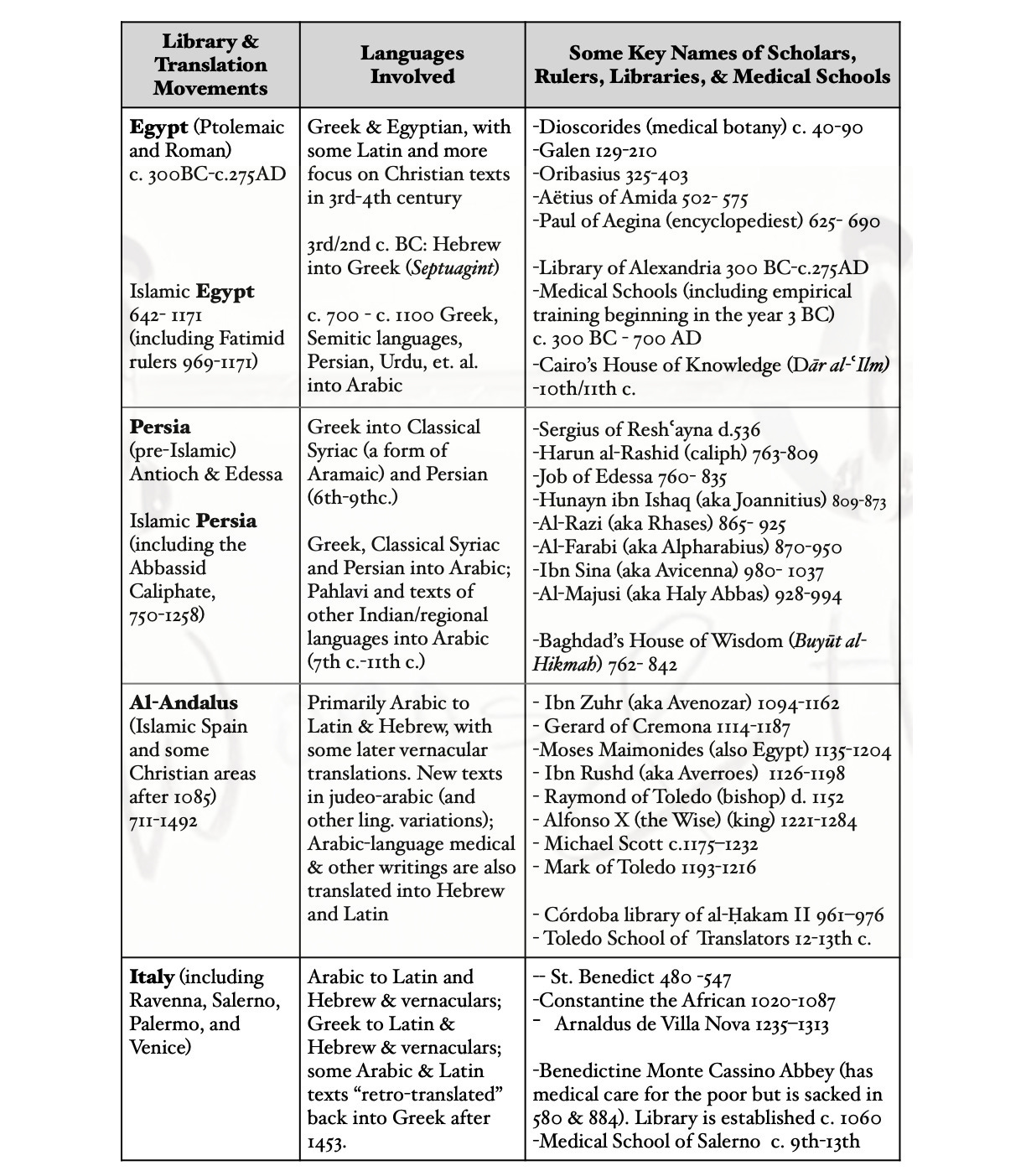
Why did leaders from the caliph Harun al-Rashid in Baghdad to the Archbishop Raymond in Toledo sponsor and cultivate Translation Movements, libraries, and the study of ancient texts? I think the Library of Alexandria cast a spell over many a ruler. Just as numerous leaders would attempt to imitate Alexander the Great — Caesar, Charlemagne, and Napoleon being just three examples — so was building a library to rival the one in Alexandria considered to be a kind of proof of greatness-capital-”G”. Only a few of the political rulers were themselves intellectually inclined. Many of them sought out the classy sheen that the housing and feeding of a Translation Movement could provide. (What do we call it these days, a kind of “green-washing” by using academic institutions to bolster the reputations of politicians and rich people? I’d say “boffin-washing” works.) Rulers and leaders want to legitimize themselves by creating centers of sought-after, cutting-edge information. They want to prove that they embody, in the present, the greatness of the past.
In Translation Movements, medical texts would fit the bill particularly well. Despite religious bouts of retrenchment, which often would lead to the destruction of much of what we call “secular” or “creative” works, no Islamic nor Christian zealot was so fundamentalist as to not want to keep a hold of ancient medical knowledge. Hippocrates, Galen, Aristotle, and the medical botanist Dioscorides would benefit from this. Scholars who had read and interpreted medical texts would similarly gain some traction. The writings of Avicenna, who was both a medical doctor and a philosopher, would be translated into Latin and known to doctors throughout the Renaissance. From Europe’s oldest medical school, in Salerno, Italy, came a kind of textbook called the Regimen Sanitatis Salerni. The commentary on it by Catalan translator and doctor Arnaldus de Villa Nova has been called the most popular medical book of the 14th century. It was often paired with anthologies of short medical tracts, “articellas,” by Aristotle, Galen, Avicenna, and al-Razi.
The combining of both Greek translations and Arabic “commentaries” (like “Translation Movement,” another vague term that obscures the analysis, evaluation, and updating going on) is worth noting as a harbinger of future, modern scholarship. Most Translation Movements can be considered secular. There was a lack of concern that one’s faith would be compromised by reading texts emerging from different belief systems. Islamic scholars, in fact, would often refer to the passages from the Quran which celebrate learning and scholarship as ways of showing the strength of one’s faith, alongside and consonant with the four pillars.
Three translation strategies to sacred texts are exceptions. In that way, they prove this “rule” (or tradition) of Translation Movements’ secular focus:
Jewish leaders translated the Torah into Greek in the 3rd century BC/BCE, and the rest of the Hebrew Bible into Greek over the following century. The result is called the Septuagint.
Jerome translated the New Testament from Koine Greek into Latin as the Vulgate in the 4th century AD/CE.
Islamic caliphs refused to support any translation of the Quran.
The Septuagint was produced out of a direct need to keep Jewish sacred texts accessible to the whole community after Hellenization (brought on by Alexander the Great) transformed daily life. Jewish communities needed Greek versions to read.
In contrast, Jerome (347-420) was not concerned with loss so much as improvement and consolidation. He found discrepancies between Greek New Testament manuscripts and the old Latin translations of Origen. He also learned Hebrew and Aramaic in order to produce a Latin version of the Old Testament. Jerome was improving existing translations for the pope of his day. His job was to establish the canon.
The Quran, of course, is not translated at all. Perhaps involvement in salvaging Ancient Greek texts dissuaded Islamic caliphs from wanting to perpetually have to “update” the Word of God. The Islamic conception of the “Word of God” clearly called for a very different approach than the Christian one. Better to have everyone maintain fluency and literacy in Classical Arabic than to anchor one’s sacred text to the stormy waters of language usage. Meanwhile, Judaism has held onto Hebrew, but very differently. For non-rabbis, one only has to learn enough Hebrew to get through a bar or bat mitzvah.
Not just languages change, but writing and researching practices change. I’m in the midst of analyzing a Tudor-era treatise on cheese, and there was no standard for spelling or citation when it was written. There are no quotation marks around quotes. The spellings of Aristotle, Avicenna, and Rhases vary across the pages. At least I can tell who is being discussed. I have seen some medieval manuscripts which are even more cryptic, where “G” only indicates a reference in the text. (You are assumed to know that that “G” stands for Galen.) In many Arabic or Latin analyses of Aristotle, he is not even named. Instead of the overspecialized jargon that dogs academia today, it would be this shortest-of-shorthand which would distinguish manuscripts of the pre-printing press scholarship.
Likewise, the practice of “translation,” and its goals, also can change dramatically across place, time, and institution. Numerous books report that Gerard of Cremona insisted upon a word-for-word correspondence between the Arabic text and his Latin translation. I find this strains credibility. Not only is this not how we would translate things today, but it also would be unusually literal in Al-Andalus. The vast majority of translations were not attempts to put a text as accurately as possible into another language, as we today would seek to do. Instead, their goal was preservation of its knowledge with the hope of expanding upon it or even correcting it.
This meant that essential lessons were consolidated. Brevity was practical. (Remember how expensive books were.) Summaries shape, significantly, the history and development of “translation”. This practice dates all the way back to the first copyists of Galen and Aristotle. And because scholars like Avicenna were elaborating and analyzing their works, subsequent “translators” would fold those insights into their books in Latin or any of the new-fangled vernaculars. More than just copying — the image of a muted monk-scribe from The Name of the Rose comes to mind — scholars involved in Translation Movements really engaged with the texts and contributed to the intellectual tradition.
And, of course, politics change the willingness for there to even be any interest in (or tolerance for) Translation Movements. Those big, ruler-financed ones do not encompass all the translating that was taking place. For every Translation Movement, sponsored by some caliph, king, or archbishop, there were individuals or circles of folks engaged in translation without political or financial support. The more I looked, the more I found lone translators trying to sustain disintegrating texts.
Translating in such cases was politically risky. Interest in the wrong books at the wrong times could get you jailed or worse. Translators working outside of the state- or church- sanctioned programs can perhaps be thought of as “prematurely lexical,” along the lines of how the Lincoln Brigade soldiers got into trouble for being “prematurely antifascist.” Think of William Tyndale’s 1526 translation of the New Testament, which was confiscated, burned, and outlawed. Tyndale was executed in 1536. Just three years later, Henry the VIII will use Tyndale’s work in the first authorized bible of the Church of England. Moreover, the 1611 King James Bible is mostly taken from Tyndale: “It has been reckoned that ninety per cent of Tyndale’s translation stands unaltered in the King James Version of 1611 (the ‘Authorized Version’), and some eighty per cent or more in the Revised Version of 1881 and 1885.”(Coggan, p.19).
So being too early can get you into trouble. It can also get you plagiarized, appropriated, and lauded (if only posthumously). Credit will be taken. So while I am grateful for the well-funded Translation Movements, my heart goes out to the translators and interpreters who had to be furtive or whose permission to study got pulled out from under them. Boethius (480-524), dying after his fickle king and patron Theodoric switched from supporting him to putting him in prison, is another such example.
You Have to Be Carefully Taught
I am slightly obsessed with Translation Movements because I learned of them late. Too late. I had been studying philosophy for nearly two decades when I came across a 2004 book that made me quite certain that, even with my liberal arts college and graduate school(s) background, I had been profoundly miseducated. The book was Aristotle’s Children by Richard E. Rubenstein.
I realized my ignorance because Richard E. Rubenstein articulated his shock, and even shame, at learning certain basic facts about Translation Movements. Then, just a few months ago, I was reading another scholar express those same feelings in a book published in 2019. I had hoped things had changed. Looks like not. I’ll let this most recent scholar articulate it. Violet Moller states her surprise:
I studied Classics and history throughout my time at school and university, but at no point was I taught about the influence of the medieval Arab world, or indeed any other external civilization, on European culture. The narrative for the history of science seemed to say, “There were the Greeks, and then the Romans, and then there was the Renaissance,” glibly skipping over the millennium in between.
What we have all responded to is a very basic fact. An omitted, elided, erased, or denied fact regarding the dynamics of Translation Movements and who was key to the survival of Ancient Greek texts. Moller puts it succinctly:
[Scholars] who were of various faiths and origins, but were united by the fact that they wrote in Arabic, had kept the flame of Greek science burning, combining it with other traditions and transforming it with their own hard work and brilliance -- ensuring its survival and transmission down through the centuries to the Renaissance.
Given the number of advanced degrees from prestigious universities that Moller, Rubenstein, and I have accumulated, this sense of surprise does not seem to be accidental. We were carefully taught. (I hope you were taught better, but I’m guessing not.) Scientist and BBC documentary host Jim Al-Khalili, in the epigraph to his 2010 book The House of Wisdom, is in despair about the same thing. And for good reason:
[T]he teaching of science in the Muslim world today follows the Western narrative. While it is not surprising that European children are taught that Copernicus, Galileo and Kepler were the fathers of astronomy, that nothing of note came before them, it is rather more disappointing that children in the Muslim world are taught the same thing. Might they not sit up and take notice if they were told that most of the stars we see in the night sky have Arabic names? For instance, the names of five of the seven main stars that make up the constellation Ursa Major (or the ‘Great Bear’) — also known as the Big Dipper or the Plough — are Arabic in origin: Dubhe, Megrez, Alioth, Mizar and Alkaid.
Rubenstein describes the Latin-speaking West’s “discovery” of Aristotle’s books as ”not discovered written in Greek and stored in clay jars, but written in Arabic and housed in the libraries of the great universities at Baghdad, Cairo, Toledo, and Cordoba.”(p.4) I may quibble with Rubenstein’s calling them “universities” here. The entities housing the Translation Movements had no students seeking degrees. There were scholars of many religious and linguistic backgrounds cooperating on translating Greek -- but not only Greek -- texts into numerous languages. Baghdad’s “House of Wisdom” was established in the 8th century with the same kind of “beacon of learning” goal that Alexandria’s Library had been established in the 4th century BC/BCE. Whether you want to call the places where Translation Movements occurred research institutes, think-tanks, libraries, learning labs, or just schools, the fact is that Islamic and Arabic-writing societies were in the midst of a Golden Age while Western Europeans were bogged down in the Dark Ages.
Rubenstein asks why “we continue to tell the story of modernism as if it began with the sixteenth-century Renaissance.” It is because, he guesses, that ”[i]f the story that Western Civilization tells itself, since the Renaissance, that it is the keeper of the flame of Greco-Roman traditions in law, science, medicine, and culture, then it may be awkward to recall that Europe depended upon Muslim and Jewish scholars for the recovery of its classical heritage.”(p. 6-7) Certainly the British Empire’s focus on inheriting the mantle of Greco-Roman “civilization” plays a part. In America, it may be an (un?)intentional holdover of what Edward Said has called Orientalism in scholarship. Our foreign policy continues to use the same old excuses.
This is a whole chapter of intellectual and scientific history that needs to be better known. Latin became a lingua franca only after Arabic had played that role for centuries. We see where scholarly efforts like the ones in Al-Andalus tapped into three, four, or five language and writing practices simultaneously. This overlap meant that Arabic was still crucial even as Latin translations were being worked on. The 12th century’s Gerard of Cremona learned Arabic in order to translate Galen into Latin around the same time (and also in Spain) that Ibn Rushd (aka Averroes) was reading and responding to Avicenna’s analyses of Galen. Moses Maimonides, born, like Averroes, in Cordoba, wrote in Judeo-Arabic, not Hebrew. Judeo-Arabic is the name for the Arabic language when it is written using Hebrew letters. Maimonides’ use of it was hardly exceptional. The historical ebbs and flows of alliances (and battles) between Christian and Islamic rulers across 750-1492 Spain, as well as Andalucia’s mix-and-match culture, would have all sort of impacts upon how writing happened. Wrap your head around these other flavors of lingua-franca-informed literacy (Constable, xxxii):
[T]hese medieval texts were written in many different languages. Christians wrote in Latin and later in Romance vernaculars, including Castillian, Catalan, Portuguese, and Galician. Muslims generally wrote in Arabic, though the Mudejars (Muslims living under Christian rule in the later Middle Ages) gradually created Aljamiado, a version of the Romance vernacular written in Arabic characters. Some Christians also used Arabic, particularly if they were Mozarabs (Arabized Christians, usually living under Muslim rule). Similarly, Jews living in Muslim Spain often wrote in Arabic (or Judeo-Arabic, a version of Arabic written in Hebrew characters), especially for secular documents, but their primary literary and religious language was Hebrew.
1453 and All That
The preponderance of Arabic-language Translation Movements allowed translators like Gerard of Cremona to read ancient Greek texts in Arabic and to translate them into Latin. However, in the rather insular Byzantine Empire, Greek manuscripts were known to be maintained and treasured by Greek Orthodox Christian scholars.
Everything in the table above documents scholarship which occurred centuries before the fall of the Byzantine Empire in 1453, when Constantinople became Istanbul. That event spurred these scholars to flee to parts of Europe. With them they brought Greek copies of Galen, Aristotle, &c. The manuscripts resulting from the long haul of Greek-to-Syriac-and-Persian-and-Hebrew-to-Arabic-to-Latin, and all other efforts, began to be compared with Greek “originals.” Of course they were not actually originals. The Constantinople manuscripts were as prone to 1000+ years of copying and/or “elucidation” over time as the earlier versions. The idea of persecuted Christians — albeit Greek Orthodox ones— fleeing with documents “in the original Greek,” however, fit with the West’s nascent story of itself. It also bolstered the increasingly fundamentalist policies of Christian kings and popes alike. The kinds of alliances and sharing found among Toledo’s School of Translators, where Archbishop Raymond was buried in Catholic garb decorated with Arabic designs, were unimaginable by the 16th century.
The year 1453 is within spitting distance of the unveiling of Gutenberg’s invention. Around 1455 the Gutenberg Bible will be published. The printing press will ramp up production of whatever information (or disinformation) anybody wants to promote. Both the upsides and the downsides of movable type provoked dizzying changes in governance, education, the arts, and the sciences. And economies. In this way, we can look at results of the mid-15th century’s explosion of printing presses as comparable to the same wreaked havoc (and speedy convenience) that we are finding today with the internet.
The printing press played its part in both the appreciation of art and science as well as in re-defining who could be named “great-capital-G”. Among trained medical professionals, names like Avicenna and al-Razi would still be known. But daily life in Western Europe between 1029 and 1529 became increasingly hostile toward non-Christians. The expulsion of Muslims from 1492 Spain was one event among many. Between all the papal decrees, royal expulsions, embargoes, crusades, inquisitions, purges and pogroms, Western Europe’s intolerance of Muslims and Jews had a palpable effect upon the population. According to Professor Şener Aktürk, the impact was measureable: “By the early 1500s, if not earlier, Western Europe emerged as the most religiously homogeneous region in the world.”
Under such circumstances, the story of the Greek “original” manuscripts escaping 1453’s Constantinople - as the BBC World Service still called Istanbul until a decade ago - could allow Europeans to treat Ancient Greek texts as if they were pristine and untouched by “heathens.” The myth of Christians upholding the Greco-Roman intellectual tradition could be fostered. The many Greco-Arabic Translation Movements could be downplayed.
Violet Moller tells the story of a Salerno medical school translator, Constantine the African, who in the 11th century was a “man before his time” in all the wrong ways. He relied upon Arabic versions of Galen but told people he was translating from Greek manuscripts. Not only did he lie about his sources, but he consciously erased the work of Arabic scholars (Moller, Salerno chapter):
Although much of Constantine’s text is based on the Kitab Kamil - The Complete Book of the Medical Art, by Ali ibn al-Abbas al-Majusi (d.982), it is far from a faithful translation; it is truncated in some places and expanded with alternative sources in others. Constantine makes no mention of al-Majusi, or indeed the authors of the other sources he included, seemingly presenting it as an original work. He also edited out all al-Majusi’s references to earlier Arabic scholars, instead prefacing the translation with a list of the sixteen books in the Alexandrine curriculum — effectively erasing the Arab contribution and emphasizing the importance of Galen.
Moller adds that “accusations of plagiarism” by 21st-century historians are understandable, but that it may be that Constantine simply was reading the room, as it were. Regional battles between Christians and Muslims in Italy, the papal bull calling for the first Crusade in 1096, and increased division among followers of Islam, created a backdrop in which patronage for scholarship might depend upon funding from the most parochial of rulers.
Constantine’s plagiarism and erasure would become mechanized. The printing press, after millennia of Translation Movements had produced treasured, hand-written manuscripts, would fulfill the promise of all those library-builders and scholars. It would also make it possible to obscure or distort who wrote what by hand. Or who wrote anything at all. Manuscripts would become the antiquated inventories of closed archives while printed books would multiply, circulate, and reframe the historical record.
With this in mind, it feels appropriate to end my brief foray into the history (and historicity) of Translation Movements with the great insight from Walter Benjamin’s “Theses on the Philosophy of History” (p.256):
“There is no document of civilization which is not at the same time a document of barbarism.”
Bibliography and Online Resources
The topic of the sprawling, many-sided, and geographically distinct Translation Movements means that each scholar, who is trying to get their head around it, ends up focused on one aspect. It is as if we each are one of the blind men trying to describe the proverbial elephant. Included with quoted sources is a selection of books, articles, exhibits, and online resources which explore medieval manuscripts and Translation Movements:
Abdel-Halim, R.E., “The role of Ibn Sina (Avicenna)’s medical poem in the transmission of medical knowledge to medieval Europe”, Urology Annals, Jan 6(1):1-12, 2014. doi: 10.4103/0974-7796.127010. PMID: 24669114; PMCID: PMC3963335
Aktürk, Şener, “Not So Innocent: Clerics, Monarchs, and the Ethnoreligious Cleansing of Western Europe” International Security (journal), Volume 48, Issue 4, April 1, 2024. Open Access: Published under a Creative Commons Attribution 4.0 International (CC BY 4.0) license. Link: https://direct.mit.edu/isec/article/48/4/87/121307/Not-So-Innocent-Clerics-Monarchs-and-the
Al-Khalili, Jim. The House of Wisdom: How Arabic Science Saved Ancient Knowledge and Gave Us the Renaissance, New York, Penguin Press, 2010.
Alwishah, Ahmed, and Hayes, Josh, Aristotle and the Arabic Tradition, Cambridge, Cambridge University Press, 2015.
Benjamin, Walter, Illuminations: Essays and Reflections, Arent, Hannah, ed. and introduction (1968) Zohn, Harry, trans. (1968, Harcourt Brace Jovanovich), New York, Schoken Books, 1985.
British Library: Incunabula Short Title Catalogue (ISTC). Link: https://data.cerl.org/istc/_index/author?term=a&direction=next
Coggan, Donald, The English Bible. British Council and the National Book League, Longmans, Green, & Co., London, 1963.
Consortium of European Research Libraries (CERL): Material Evidence in Incunabula (MEI). Link: https://data.cerl.org/mei/_index/owners?term=a&direction=next
Constable, Olivia Remie, ed., Medieval Iberia: Readings from Christian, Muslim, and Jewish Sources, Second edition, published by the University of Pennsylvania, Philadelphia, 2012.
Griffith, Sidney H. The Church in the Shadow of the Mosque, Princeton, Princeton University Press, 2008.
Moller, Violet, A Map of Knowledge: A Thousand-Year History of How Classical Ideas Were Lost and Found, New York, Vintage, 2019.
NIH-NLM Online Exhibit: An Odyssey of Knowledge: Medieval Manuscripts and Early Printed Books from the National Library of Medicine, National Library of Medicine, NIH, Bethesda, MD, 2012.
O’Shea, Stephen, Sea of Faith: Islam and Christianity in the Medieval Mediterranean World, New York, Walker & Co., 2007.
Regimen Sanitatis Salerni, English translation: The University of Michigan’s full-text version of Thomas Paynell’s 1528 English translation of the Latin medical textbook Regimen Sanitatis Salerni is on their Early English Books Online site. Link: https://quod.lib.umich.edu/e/eebo/A11336.0001.001/1:4?rgn=div1;view=fulltext
Rubenstein, Richard E., Aristotle’s Children: How Christians, Muslims, and Jews Rediscovered Ancient Wisdom and Illuminated the Middle Ages, New York, Harvest, 2004.
Savage-Smith, Emilie, Islamic Medical Medical Manuscripts at the National Library of Medicine, History of Medicine Division of the National Library of Medicine, NIH, Bethesda, MD, 2010.
Sergius of Reshʿayna: A Syriac translation of Galen’s Simple Drugs by Sergius of Reshʿayna found within, palimpsest-like, another book: journal article (2013), news article (2015).
Stewart, S.J., trans., Boethius: The Consolation of Philosophy, Loeb Classical Library 47, Cambridge, MA, Harvard University Press, 1973 (trans.), 1997 (edition).
Vallejo, Irene, Papyrus: The Invention of Books in the Ancient World, Whittle, Charlotte, trans., New York, Alfred A. Knopf, 2022.
Vagelpohl, U., “Dating Medical Translations: Hunayn ibn Ishaq of Galen/Hippocrates in Epistle (Risala)”, Journal of Abbasid Studies, 2(1):86-106, 2015. doi: 10.1163/22142371-12340015. PMID: 29809206; PMCID: PMC5967603.
Young M.J.L., Latham J.D., Serjeant R.B., editors, “Religion, Learning and Science in the Abbasid Period”, The Cambridge History of Arabic Literature. Cambridge University Press, 1990.
A really informative post. Thank you!